
Headnote
Ms Devanshi Saxena of the University of Antwerp on why India protects geographical indications, and whether the law delivers.
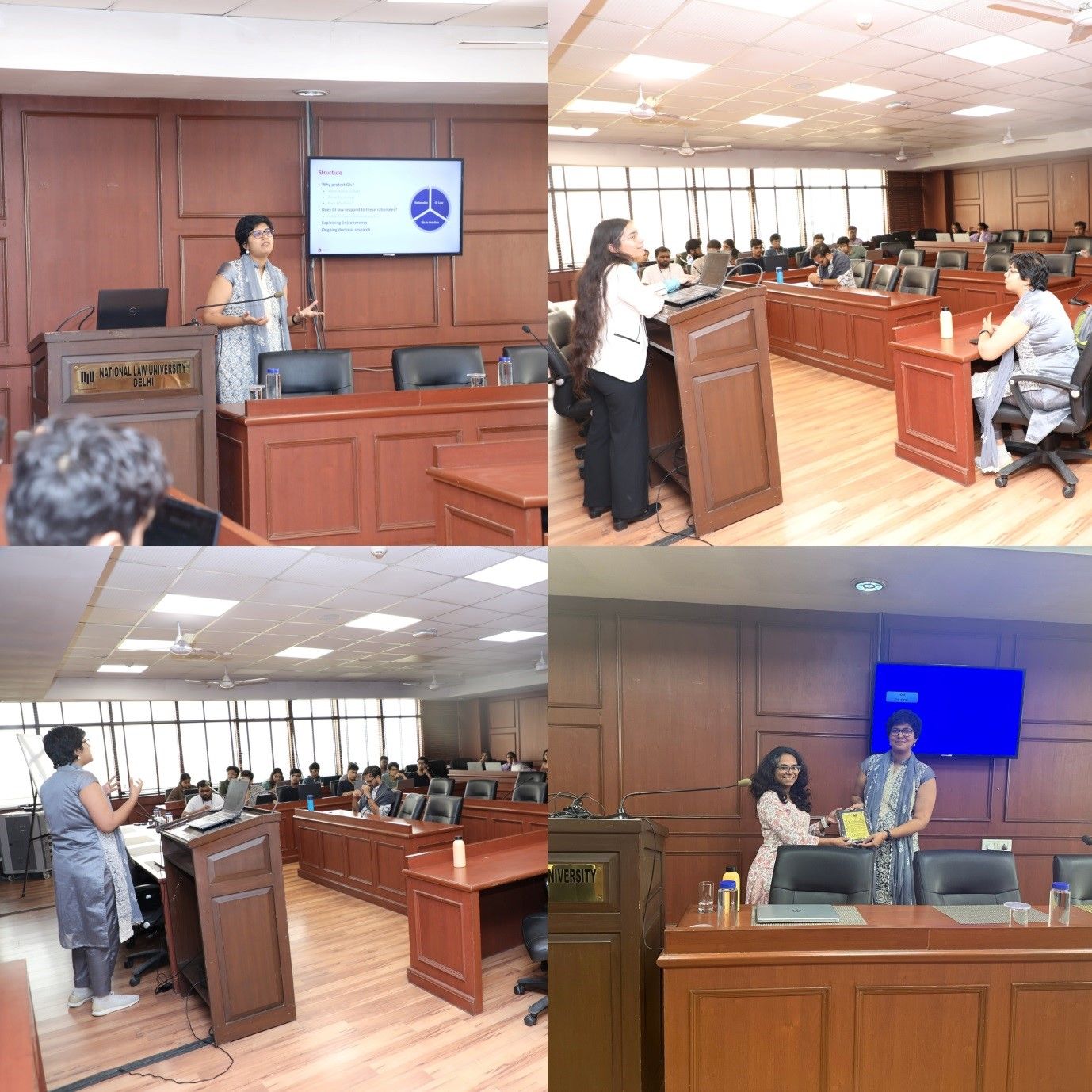
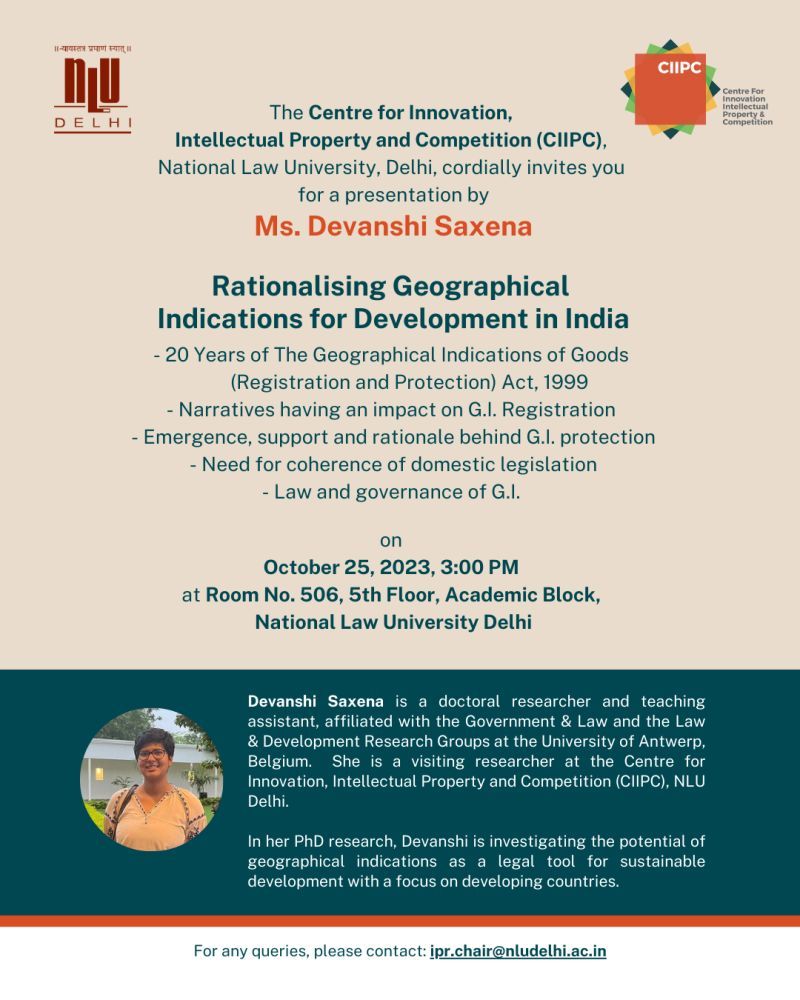
0001On 25th October, 2023, the Centre for Innovation, Intellectual Property and Competition, National Law University Delhi, organised a special lecture by Ms. Devanshi Saxena, Doctoral Researcher and Teaching Assistant, University of Antwerp, Belgium, on the topic “Rationalising Geographical Indications for Development in India”. The lecture was held at 3:00 PM in Room 506, Academic Block, National Law University Delhi.
Discussion on Geographical Indications
0002The lecture discussed the development of the Geographical Indications framework in India. At the time of the lecture, the Geographical Indications Act had completed 20 years of enactment, during which more than 475 products had been registered as Geographical Indications.
0003The discussion examined the different rationales associated with GI protection, including the preservation of cultural heritage, protection of producer identity, social cohesion, economic development, increased trade, and export promotion.
0004Ms. Saxena used Darjeeling tea as an example to examine the rationales for protecting a product as a GI. These included protecting cultural pride, providing incentives for production, improving product quality, and complying with the TRIPS Agreement.
0005The lecture considered whether GI law can effectively respond to these different objectives and what an effective legal response would require. Ms. Saxena encouraged reflection on the domestic rationales for GI protection and the need for coherence between these rationales, the law, and the governance of GIs.
0006She also discussed her experiences with case studies involving Chanderi sarees in India and Rooibos tea in South Africa. Particular attention was given to the pre registration phase of GI protection. The discussion highlighted the importance of representation for producer bodies, as producers are the people who should be protected through the GI framework.
0007The lecture also suggested the need to reconsider the existing approach to GI protection and examine the role played by government agencies in scrutinising GI applications.
Speaker
0008Ms. Devanshi Saxena is a Doctoral Researcher and Teaching Assistant affiliated with the Government and Law and Law and Development Research Groups at the University of Antwerp, Belgium. She was also a visiting researcher at CIIPC, Delhi, from 15th June to 31st October, 2023.
0009Her doctoral research examines the potential of geographical indications as a legal tool for sustainable development, with a focus on developing countries. Her research adopts a critical decolonial approach to discussions on sustainable development through geographical indications and explores the intersection between sustainability, development, and intellectual property.
Plates
2 photographs from the record. Select one to see it full size.
Cite as
‘Rationalising Geographical Indications for Development in India’ (2023) CIIPC Rec 5, Centre for Innovation, Intellectual Property and Competition, National Law University Delhi <https://ciipc.pages.dev/events/gi-for-development/>
9 numbered paragraphs, from the Centre’s events record. Corrections to ciipc@nludelhi.ac.in.